French Calvinists
The Three MusketeersFrench Calvinists form the organized Protestant community whose remaining political and military center is La Rochelle. In the novel’s seventeenth-century France, they are not presented merely as a religious minority but as a collective power intertwined with civic autonomy, foreign intervention, rebellion, and the struggle between the crown and Cardinal Richelieu. Their stronghold becomes the point at which confessional conflict, royal centralization, international war, and private ambition converge.
Origins and Political Position
French Calvinists had once possessed several important places of safety granted by Henry IV, but La Rochelle remained the last of those major fortified cities. Its survival gave the community a durable political and military center after the ruin of the other Calvinist cities. The city therefore represented more than a local population holding a different confession: it was the final visible bulwark of Calvinism within the French kingdom, and its continued independence allowed religious dissent to retain a territorial base.
The narrative places this community within a France already habituated to overlapping conflicts. Citizens confront nobles, the king, the cardinal, Spain, robbers, mendicants, Huguenots, wolves, and other enemies as though war were a permanent condition of public life. Yet the civic response is politically selective: townspeople readily arm themselves against thieves, wolves, and scoundrels, often against nobles or Huguenots, sometimes against the king, but never against the cardinal or Spain. This pattern reveals how the word Huguenot carries a political charge beyond theology. French Calvinists are treated as an established category of danger within a society whose loyalties are shaped by authority as much as by religion.
La Rochelle as Stronghold and International Node
La Rochelle’s importance increased precisely because the other Calvinist cities had fallen. Its port was also the last harbor in France open to England. That geographical fact transformed the city into an international strategic node: control of La Rochelle would not only suppress French Calvinist resistance but also deny England a maritime entrance into the kingdom. Richelieu could therefore represent the siege as both the destruction of a domestic religious threat and the completion of a national defense against France’s “eternal enemy,” England.
The city’s Protestant cause attracted support from far beyond its walls. Spaniards, Englishmen, Italian malcontents, adventurers from many nations, and soldiers of fortune belonging to different sects gathered at the first summons beneath the Protestant standard. Their organization is described as a vast association whose branches extended across Europe. French Calvinism thus appears as the center of a transnational network rather than an isolated local movement. Religious solidarity, political discontent, military opportunity, and opposition to French royal power reinforce one another, making the conflict impossible to contain within a purely French or purely confessional frame.
Conflict with the Crown and Richelieu
Richelieu’s stated political objective is to destroy La Rochelle as the last bulwark of Calvinism, which he regards as a dangerous mixture of civil revolt and foreign war. The siege consequently expresses the historical movement toward a more uniform and centralized French state. The French royal army does not confront only a fortified city; it confronts a competing model of authority in which a Protestant stronghold can preserve its own political weight and invite foreign assistance.
The campaign also exposes the tension between formal political reasons and private motives. Richelieu’s larger program is religious and strategic, but the narrative adds his rivalry with Buckingham over Anne of Austria. Buckingham likewise presents himself as defending England’s honor while pursuing private vengeance and seeking to enter France as a conqueror rather than as an ambassador. The real stake in the contest between the two kingdoms is reduced, with deliberate irony, to the approval of Anne of Austria. French Calvinists and La Rochelle are therefore caught inside a conflict whose public language concerns religion, national security, and sovereignty, while powerful men are also moved by jealousy and desire.
The Siege and Its Wider Consequences
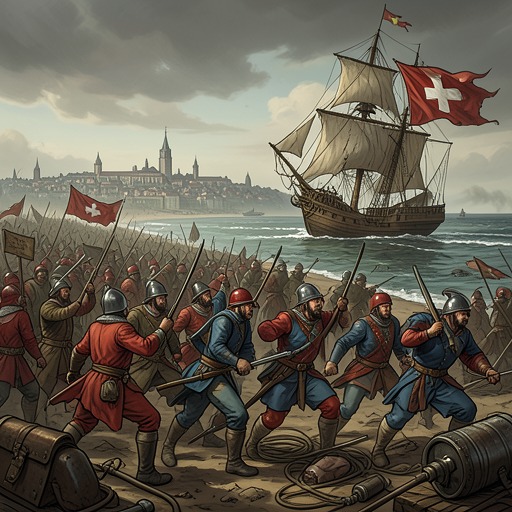
The opening of the campaign demonstrates how La Rochelle’s position draws the English directly into the conflict. Buckingham arrived unexpectedly before the Isle of Ré with ninety vessels and nearly twenty thousand men, surprised the Comte de Toiras, and landed after a bloody engagement. The French commander withdrew into the citadel of Saint-Martin, while a hundred men were placed in the small Fort La Pree. This attempted relief operation shows that the Protestant stronghold was protected by a wider Anglo-French military contest, not left to withstand the French royal army alone.
The eventual strategic balance favored the French blockade. Although La Rochelle was invested, the siege could last a long time, and the dyke prevented vessels from entering the besieged city. The blockade became an affront to the king’s army and a serious inconvenience to Richelieu, while the city endured pressure from within as well as without. La Rochelle’s mayor attempted to suppress a mutiny favoring surrender by hanging the mutineers. After that execution, the disaffected inhabitants resolved to die of hunger, regarding starvation as slower but more certain than strangulation. The episode shows a community whose resistance depends simultaneously on military defenses, civic discipline, political conviction, and the willingness to endure famine.
The siege also generated a broader intelligence and diplomatic crisis. An envoy of Buckingham, Montague, was captured, and evidence was obtained of a league joining the German Empire, Spain, England, and Lorraine against France. Papers discovered in Buckingham’s hastily abandoned lodging confirmed the alliance and implicated Madame de Chevreuse and, consequently, the queen. The campaign therefore supplied Richelieu with information that connected La Rochelle to a European coalition and intensified the political danger surrounding the French court.
Historical and Narrative Significance
The fate of French Calvinists is presented as a turning point in the religious history of France. Bassompierre, both Protestant by conviction and Catholic as commander of the Order of the Holy Ghost, recognized the grim irony of attacking La Rochelle and predicted that those taking it would prove themselves foolish. The cannonade of the Isle of Ré appeared to him as a prelude to later persecution in the Cevennes, while the fall of La Rochelle became the preface to the revocation of the Edict of Nantes.
French Calvinists consequently occupy a double position in the narrative. They are an immediate military opponent of the French crown and, at the same time, the historical sign of a larger transformation: the narrowing of tolerated religious pluralism under centralized royal authority. Their stronghold links local resistance to European networks, naval power to confessional politics, and the machinery of siege to the reorganization of the kingdom. Even when individual adventures move through Paris, London, or the royal camp, the presence of French Calvinism remains a structural pressure behind the plot, turning private missions and court intrigues into episodes within a much larger struggle over who may possess security, allegiance, and political space in France.